
Every year, association boards gather to map out their vision for the future of their organization. Translating these ambitions into reality, however, is easier said than done. In fact, only 12.5% of strategic projects actually materialize.
Strategic planning is the key to scaling your association’s impact, enabling you to ground your ambitions in the realities of your association’s operational capacity and industry trends. To improve strategic planning, you must bridge the gap between those who design the strategy and those who execute it, increasing your resilience and influence.
In this guide, we’ll explore the essentials of strategic planning for associations, providing the insights you need to take your impact to the next level.

Frequently Asked Questions About Strategic Planning
What is strategic planning for associations?
Trade and professional associations use strategic planning to determine, pursue, and achieve their goals. Ideally, every aspect of your association’s operations aligns with your overall strategy, maximizing the efficiency of your efforts.Why does an association need a strategic plan?
Without a strategic plan, your association risks stagnation, declining member engagement, and financial instability. An expertly crafted roadmap protects your operating budget by preventing departments from pursuing projects that don’t contribute anything to your strategic vision.Can association management companies (AMCs) help with strategic planning?
Yes! You just need to choose the right AMC. Some AMCs only provide operational support. While this frees your board to focus on high-level pursuits, it doesn’t guarantee that your day-to-day operations align with your big-picture goals. To sharpen your strategy, it’s better to work with a full-service AMC that will aid both strategy and execution. These service firms help your association create data-driven goals that are both ambitious and achievable, and then provide the targeted support you need to consistently make progress toward achieving those goals.Benefits of Strategic Planning for Associations
A robust strategic plan helps your association optimize its present operations and prepare for its future. Its benefits include: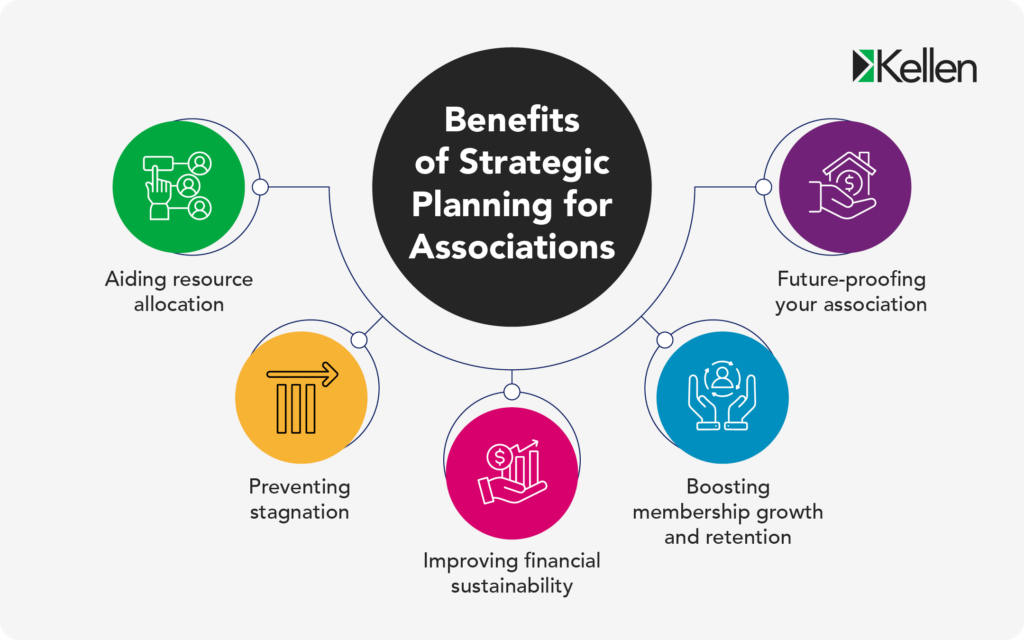
- Aiding resource allocation: When your association clearly defines its priorities, you can ensure your time, energy, and funds serve those objectives.
- Preventing stagnation: Today’s workforce is rapidly changing. In 2025, only 45% of associations increased their membership. A strategic plan helps you stay ahead of the curve and maintain relevance in your industry.
- Improving financial sustainability: Membership dues alone cannot keep your organization afloat. You need a plan to generate non-dues revenue through educational content, events, and sponsorships.
- Boosting membership growth and retention: You need a strategic plan to increase the perceived value of your membership and show members that your association is a forward-thinking organization.
- Future-proofing your association: As industry trends and policy regulations change, you need to be deliberate about staying up to date with relevant shifts and adapting as needed.
To maximize these benefits, share the need-to-knows of your strategic plan with all staff members, not just the board. When frontline workers understand the long-term vision, they can suggest practical daily improvements that leadership might miss.

Best Practices for Strategic Planning
Strategic planning requires a phased approach to ensure your plan is cohesive and logical. Here, we’ll outline the structured steps your association should follow to ensure its overarching vision translates into daily implementation.
Evaluate your current state
Before you start imagining your association’s future, you need to understand its present. Establish an accurate baseline by analyzing your association’s daily operations, financial health, and member engagement metrics. Understanding internal workflow friction provides crucial context for why past initiatives succeeded or failed under pressure.
Put these numbers in context by looking at broader industry trends. For example, if you’re a nutrition association, you should consider how current dialogs like the “Make America Healthy Again” movement might impact your ability to influence policy.
After evaluating your current standing, conduct anonymous staff interviews to uncover hidden workflow bottlenecks that you might otherwise miss. Down the line, you’ll be able to address these obstacles more effectively.
Set goals
Define ambitious yet achievable objectives based on your initial operational analysis to align priorities with market demands. As you create your goals, keep the SMART acronym in mind. SMART goals are:
- Specific
- Measurable
- Achievable
- Relevant
- Time-bound
Practice distinguishing between SMART goals and general objectives by playing the game below:
Select one primary focus area, such as member retention, and build out three specific, data-backed milestones to achieve within the first year of the plan. This approach prevents administrative teams from becoming paralyzed by overwhelming, competing institutional priorities.
Collaborate between teams
Your association’s staff teams must work together to ensure your strategic priorities align with your actual capabilities. Rather than isolating departments, encourage cross-team collaboration to hit your targets.
For example, your event planning team might need to work closely with your education team to ensure the workshops at your next conference align with member interests as determined by your learning management system (LMS) data.
Set up a shared digital folder where staff from various teams can drop notes or ideas continuously during the planning phase. Sometimes the best solutions come from employees who notice inefficiencies in how two departments interact on daily tasks.
Measure your progress
As you implement your strategic plan, you should conduct regular reviews to adapt it based on real-time operational data. Without consistent tracking, you might only realize a plan failed when the budget runs out.
Choose three to five core metrics to track consistently on a master organizational dashboard. This allows you to keep an eye on your top priorities without overwhelming your team with metrics that don’t actually matter.
During a quarterly meeting with your board, you can share these and other metrics to assess how you can fine-tune your operations moving forward. Meeting every three months keeps everyone accountable and allows you to fix problems fast.

The Role Association Management Companies Play
An association management company plays a vital role in strategic planning for associations by blending daily operational management with high-level strategic guidance. Their expertise helps your association pinpoint the right goals and follow through on your ambitions. AMCs aid your strategic planning by:
- Incorporating data into your strategy: Because an AMC manages the day-to-day operations—from non-dues revenue to public affairs—they hold the precise data needed to formulate a realistic strategy.
- Conducting market research: AMCs assist in developing and executing strategic plans by conducting in-depth market research to identify untapped growth potential. They also evaluate the effectiveness of current initiatives to ensure that organizational objectives align with financial realities and future goals.
- Closing the operational gap: To achieve your goals, you need both strategy and execution. An AMC ensures every level of your operations is working in service of your big-picture goals.
- Empowering board governance: A core function of an AMC is relieving volunteer boards of heavy daily operational burdens. This support allows board members to transition away from day-to-day management and dedicate their time to higher-level strategy.
Before finalizing your management vendor selection, require potential partners to present detailed case studies demonstrating exactly how they previously corrected a lagging strategic initiative. Evaluating their historical crisis management capabilities provides critical insight into their operational resilience under pressure.
How Kellen Sharpens and Executes Association Strategy
Kellen is a full-service association management company empowering professional and trade associations to transform their strategic vision into measurable, real-world impact. By combining deep industry expertise with an agile operational platform, Kellen ensures long-term goals are executed seamlessly.
Kellen supports strategic planning for associations through:
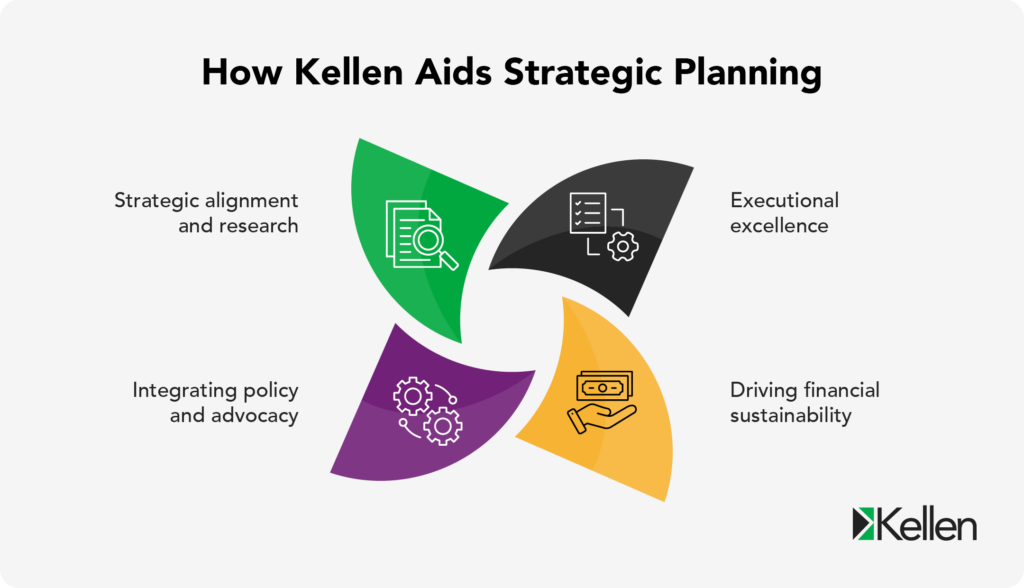
- Strategic alignment and research: Kellen begins by aligning your organization’s objectives with its mission and financial realities. Our team conducts in-depth market research and evaluates current programs to identify untapped growth opportunities.
- Executional excellence: To turn ideas into reality, Kellen deploys a unique operational framework that streamlines daily management. This executional rigor alleviates common organizational pain points, such as sudden staff turnover, financial hurdles, and program launch bottlenecks.
- Driving financial sustainability: Kellen helps associations secure their future by diversifying beyond traditional membership dues. We develop robust non-dues revenue streams, including customized sponsorship packages, targeted grants, and monetized educational programs.
- Integrating policy and advocacy: Leveraging our Washington, D.C. headquarters, we integrate proactive policy advocacy directly into your association’s broader strategy. Our critical intelligence on regulatory shifts and direct access to key federal decision-makers amplify your organization’s voice.
Ultimately, Kellen acts as a comprehensive strategic partner that goes beyond standard association management. We provide the precise mix of specialized talent and operational diligence required to elevate your association’s standing and achieve exceptional results.

Additional Resources
Strategic planning for associations clears the way for your organization to solidify its standing and grow its impact. While it requires deep insight into your industry and your specific operations, this work ultimately helps your organization operate more efficiently. Working with an AMC is the best way to hone your strategy and turn your plans into actions.
To learn more about association management, check out these resources:
- 9 Association Management Companies Driving Strategic Growth: Discover the top association management companies serving organizations like yours today.
- Elevating Strategic Partnerships: Turning Trends Into Revenue and Industry Impact: Learn how to elevate your corporate partnerships to create programs that entice sponsors and drive non-dues revenue for your association.
- Association Board Governance & Training: Review the roles and responsibilities of association board members to be the best partner you can be.